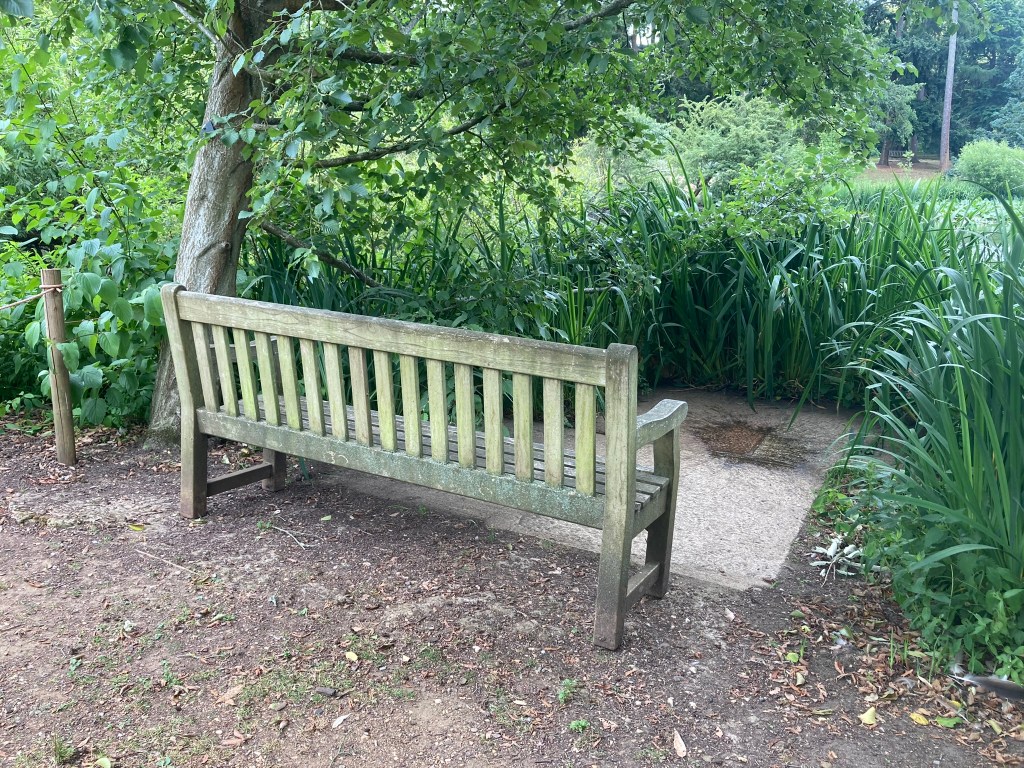
Another set of the stones identified by Vic Keegan years ago are at Kew Gardens. Keegan states “John Mowlem, the building company which demolished the bridge offered some of the surplus granite blocks – it had around 200 in all with an average weight of two tons – to Kew Gardens. Kew took four of them, conveyed in two journeys from Mowlem’s Cambridge depot, in June 1974 and placed them on the banks of the big lake near where the Sackler Crossing now is on the southern side. They were originally intended as a spot which birds could feed on but now there is a bench on top and hardly anyone knows the history beneath. ” (1)
Ray Desmond, the biographer of Kew Gardens, has these blocks appearing in 1975. “Four large granite blocks, formerly part of old London Bridge, made into a “feeding pier” for waterfowl on the Lake” (2)
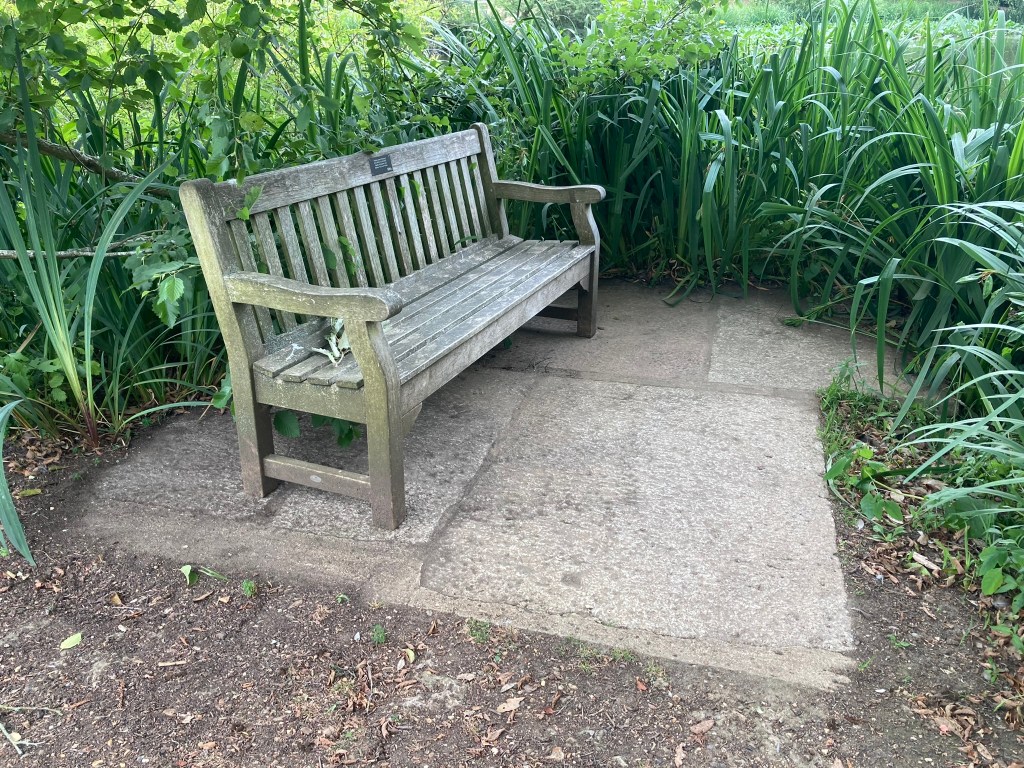
The blocks are not being used for bird feeding now as the banks of the lake have been overgrown with plants but have a bench on/by them.
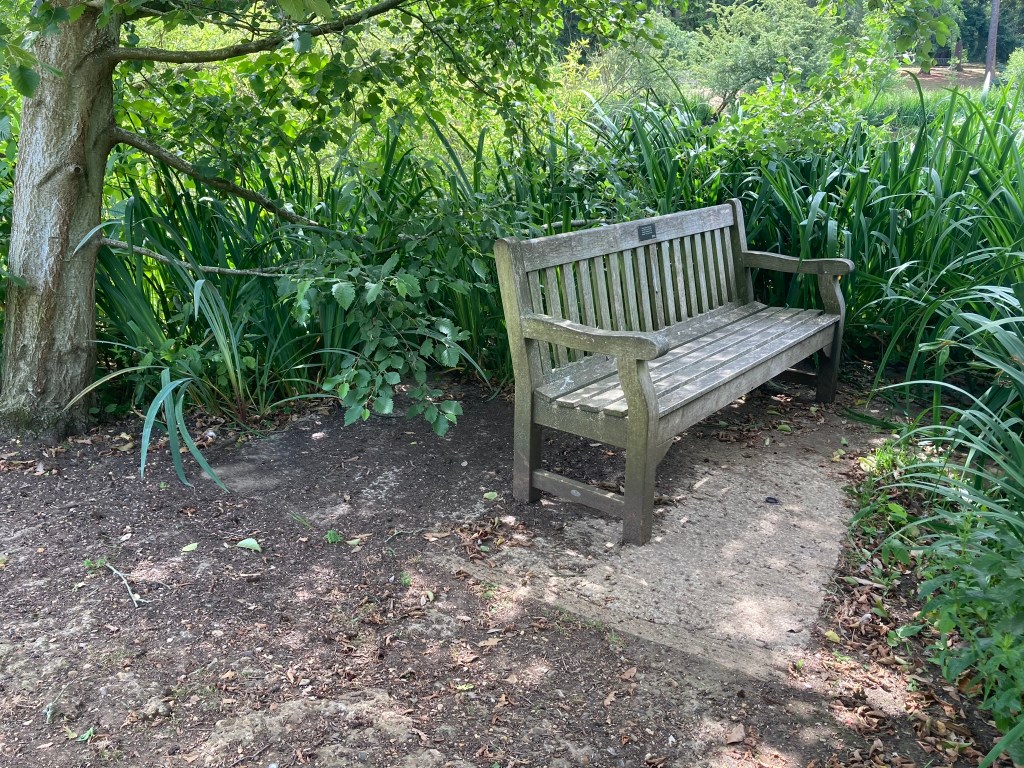
Sadly Kew Gardens are not highlighting this historic feature neither online nor in situ. An online Google search
https://www.kew.org/search?textsearch=%22london+bridge%22
gives this answer “No results… No results, please try a different search.”
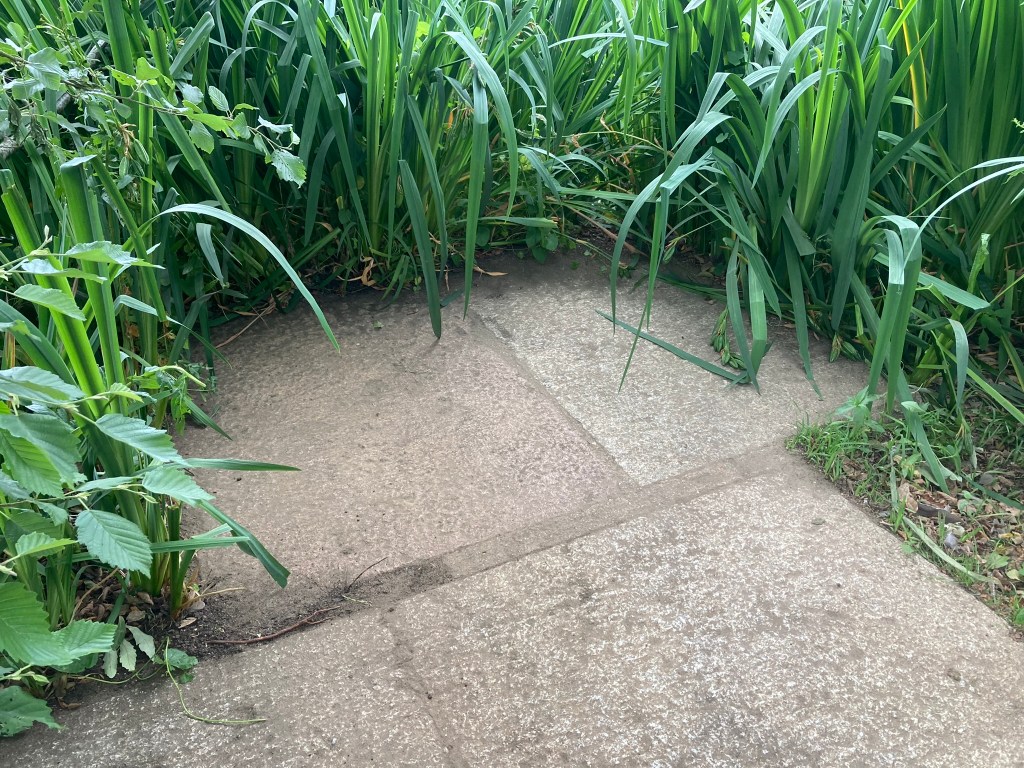
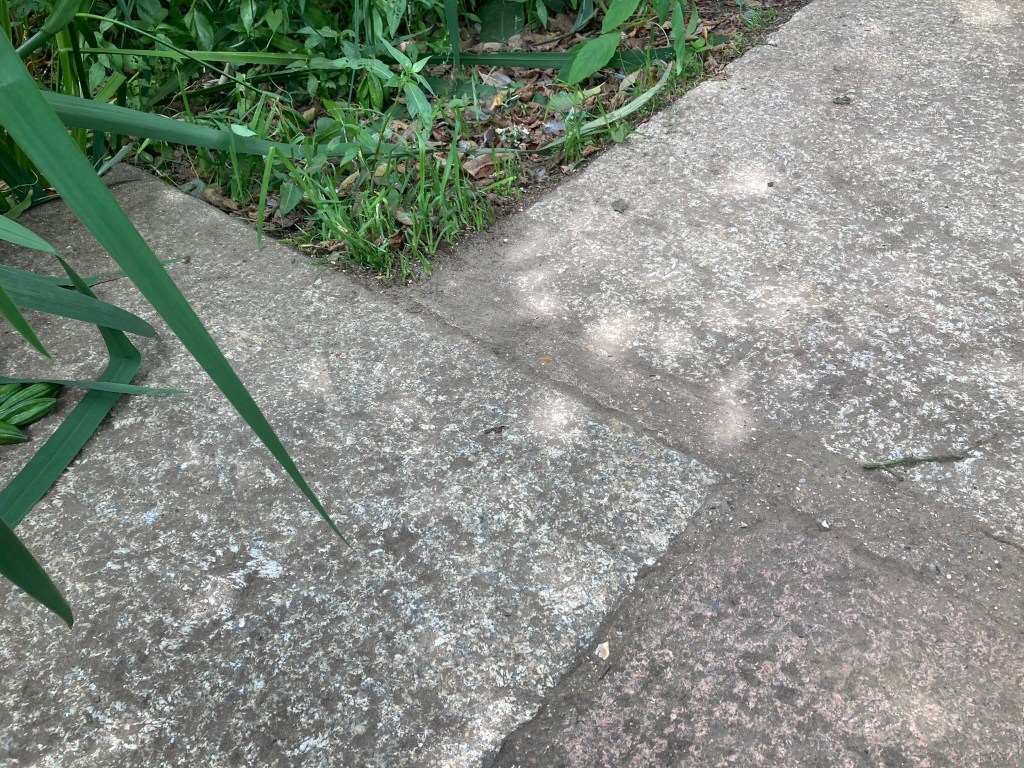
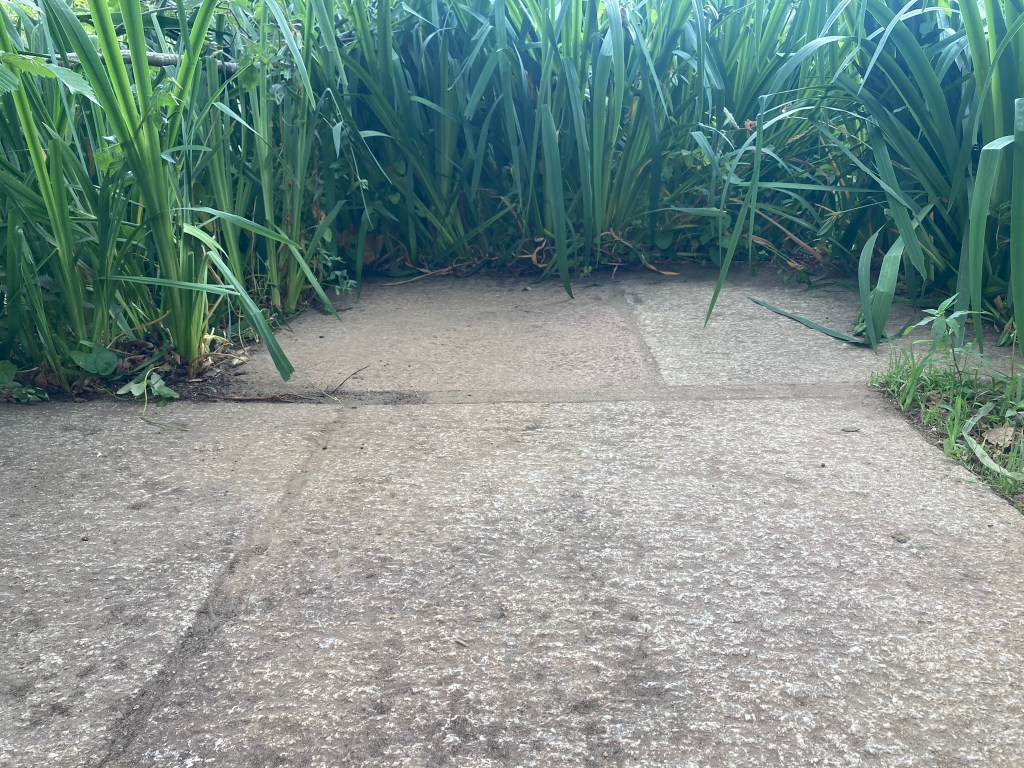
And the blocks are not being cleaned. They were covered in dirt, an inch thick and hard in some places, so clearly not just recent, but a bit of guerilla sweeping ( using windfall twigs and leaves – no plant was hurt in this process! ) saw the area looking good again and a request was later made to the very helpful woman on Information, Nim?, for these blocks to have a regular clean and also an Interpretation Board.
A couple of minutes of jet washing would have them sparkling as brightly as they would have been nearly 200 years ago! (3)
Note that while most of the 1832 London Bridge came from Haytor Quarry, when the bridge was widened in 1903, granite came from Swelltor Quarry but those were corbels so maybe not relevant here. (4)
Granite also came from quarries in Dartmoor, Aberdeenshire and Cornwall and these blocks could be from any of those quarries. (5)
It is maybe odd that when the ‘new’ London Bridge was built in the early 1970s, that Mowlem, and Merrivale Quarry (6) , where the old stones were cut down into facing stones before being sent to Lake Havasu, ended up with so much unused granite, as, as Peter Stanwick notes
“… the rebuilding of London Bridge (1971-3) required 3,000 tons of granite for the piers, supplied from Hantergantick Quarry, with granite for the parapets and cladding from Merrivale.” (7)
Why all the old granite was not re-used is unclear but that has left us with these lovely reminders dotted about though note, whole bits of Rennie’s bridge are still in place though you have to look for them! (5)
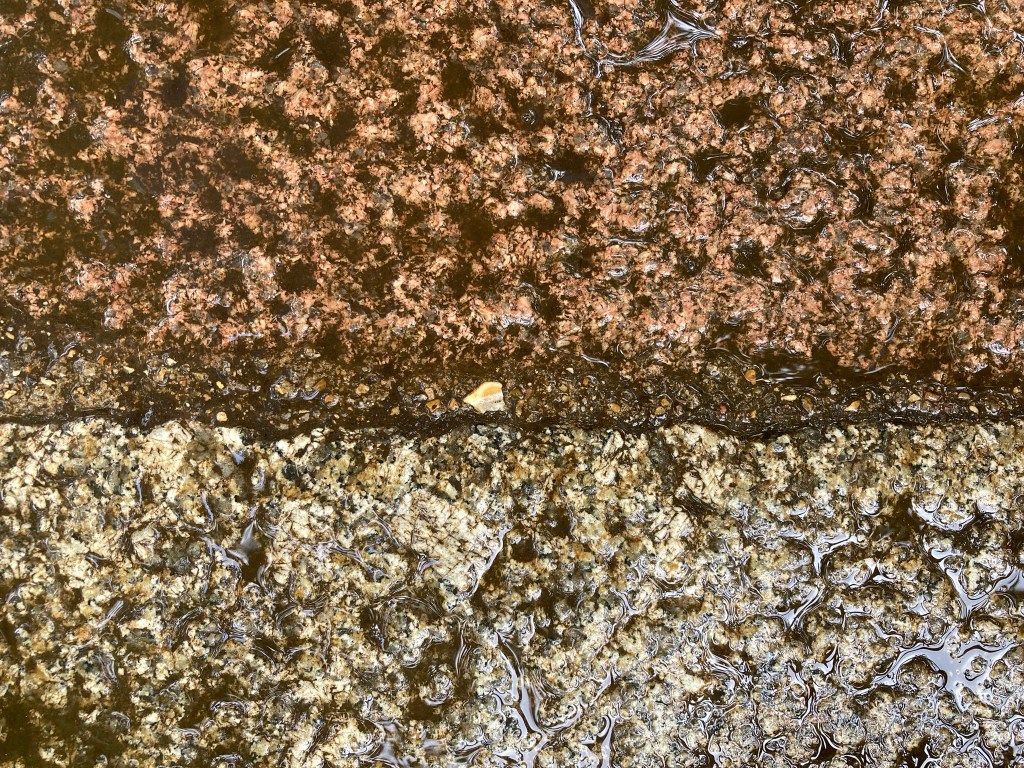
Regarding the difference in coilour of these granites, it’s worth noting that the block at the Lea Valley Sports Centre is also pinkish (8)
Getting there:
The stones are just to the east of the Lake Crossing on the north side of The Lake, no more than 10 minutes walk from the entrance of Kew Gardens. They were hard to spot initially but obvious with a closer look. Take a dustpan and brush! 😀
Kew Gardens itself is easy to get too from most of London: Go to Kew Gardens station on the the District Line and Stratford <> Richmond Overground and Kew Gardens is 5 minutes walk from the station.
Nb Kew Gardens is expensive. £25 standard rates with some concessions and it’s half price after 4pm. Check the website.
https://www.kew.org/kew-gardens
References:
1) https://www.londonmylondon.co.uk/yet-more-bits-of-old-london-bridge/
2) https://archive.org/details/historyofroyalbo0000desm/page/354/mode/2up
3) https://buildinglondon.blog/2023/10/14/65-haytor-quarry-dartmoor/
4) https://buildinglondon.blog/2021/07/31/a-visit-to-swell-tor-quarry-in-devon/
5) https://buildinglondon.blog/2023/04/08/61-re-discovering-rennies-london-bridge-at-london-bridge/
6) https://buildinglondon.blog/2023/11/08/67-merrivale-quarry/
7) The Granite Industry Of South-West England, 1800-1980: A Study In Historical Geography: Peter Stanier
https://eprints.soton.ac.uk/413336/1/85075041.pdf
8) https://buildinglondon.blog/2021/08/10/london-bridge-picketts-lock/
It was probably too dirty but see above.


 Building London - what London is made from and where it came from!
Leave a reply to Tony Cancel reply