Readers will know this blog has a particular interest in old/ancient pavement and has previously suggested that the cobbles and boulders of Upper Watergate Street in Deptford may be the oldest visible and active, road surface in London – [ this bold assertion is still unchallenged! 😀 ] – and noted another very old pavement at Deans Yard in the old confines of Westmister Abbey.
See previous posts
’21: Upper Watergate Street in Deptford – maybe the oldest existing street surface in London!’ https://buildinglondon.blog/2021/12/12/21-upper-watergate-street-the-oldest-street-surface-in-london/
’65: The cobbles of Dean’s Yard, Westminster.’ https://buildinglondon.blog/2023/05/04/65-the-cobbles-of-deans-yard/
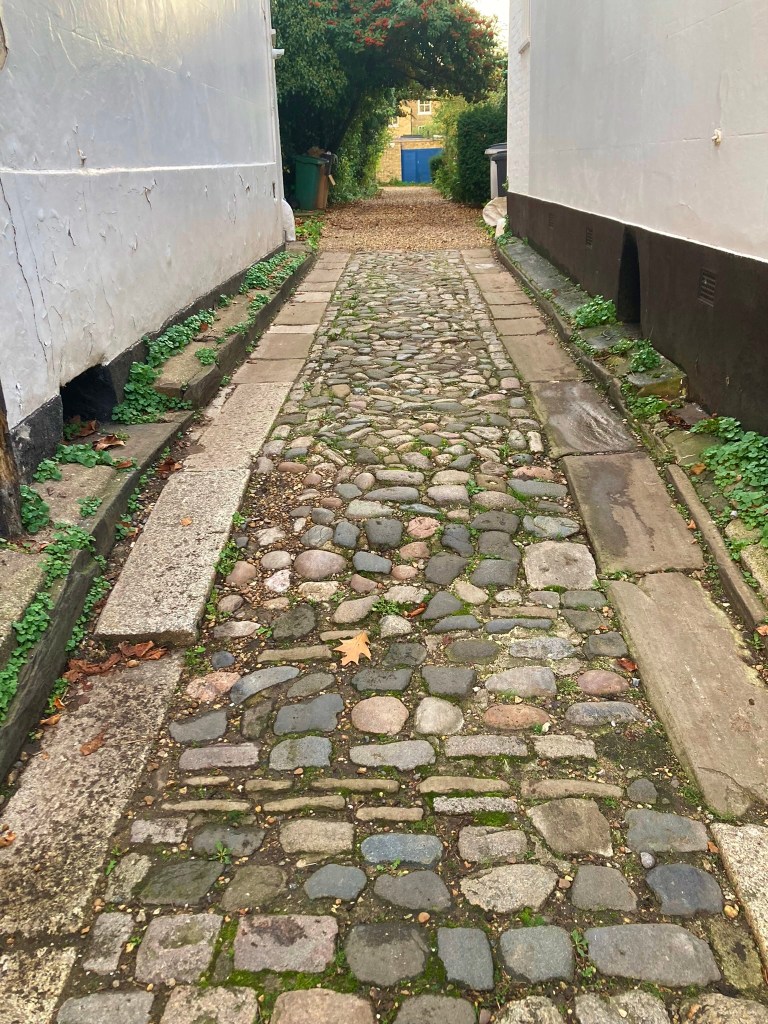
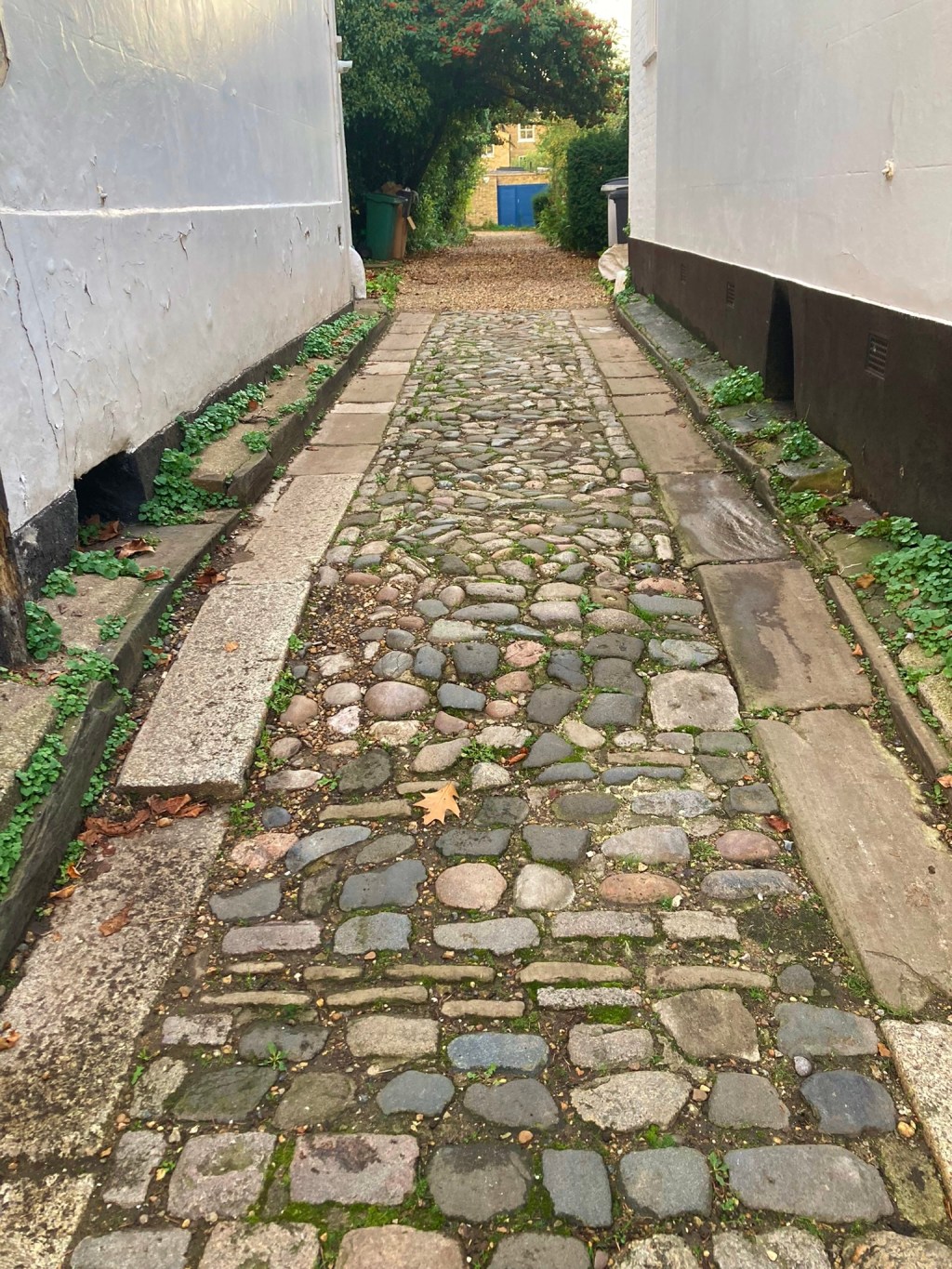
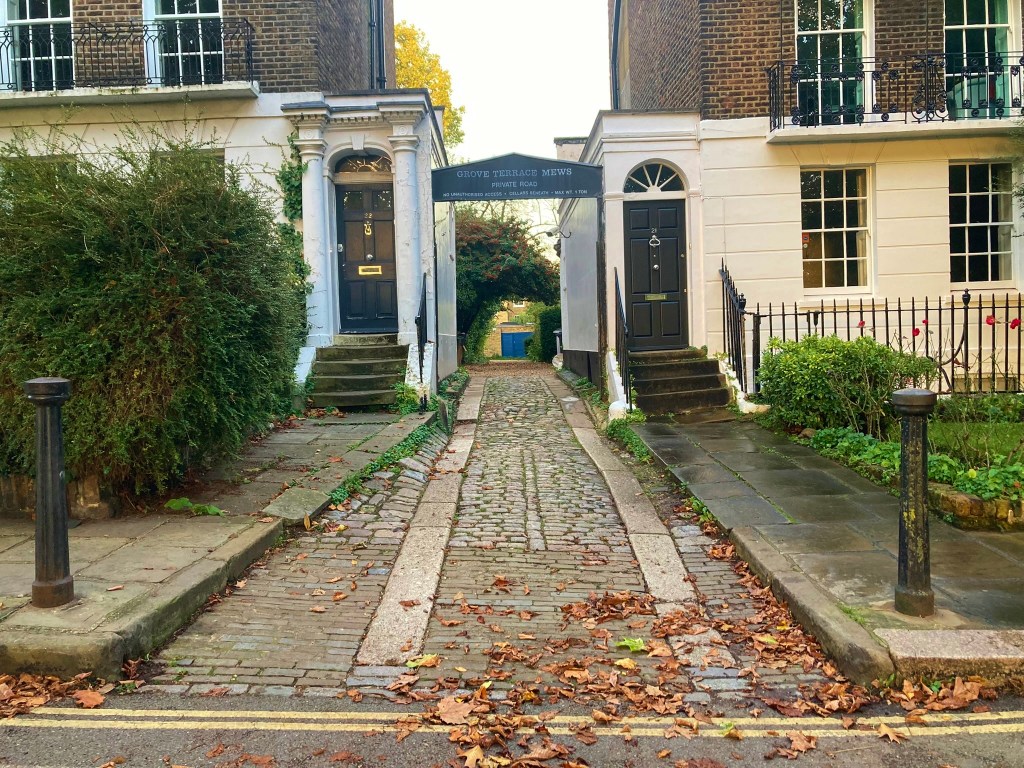
Now another similar road surface has been seen by chance and this one is interesting as it can be fairly clearly dated, to around 1780.
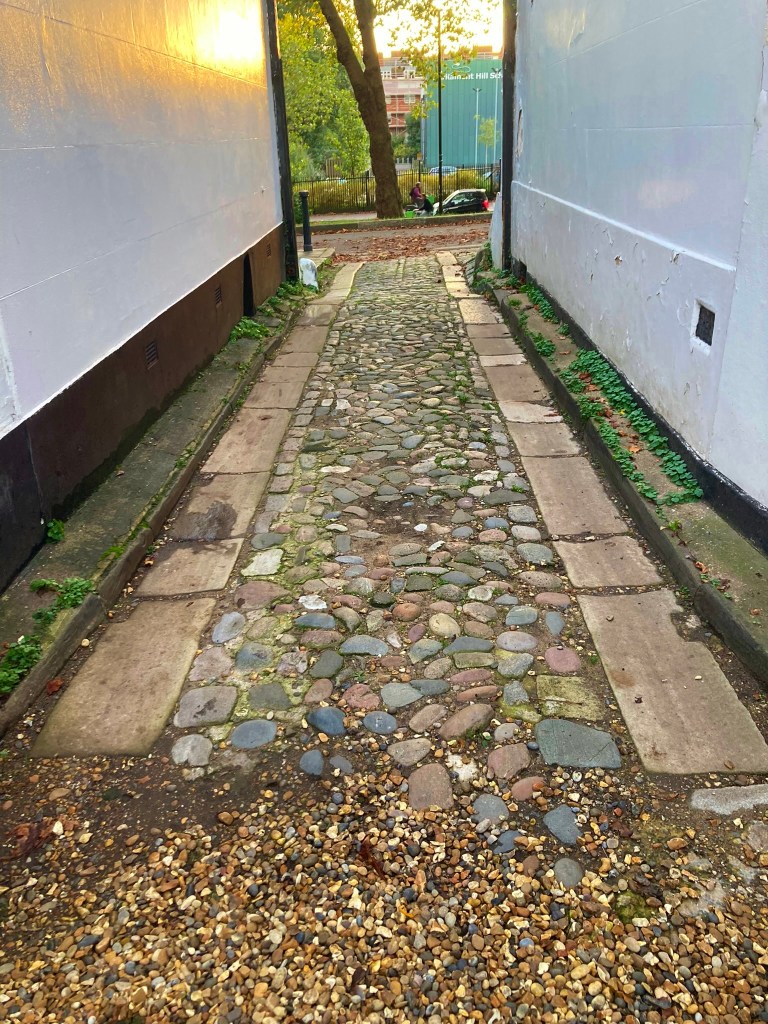
The roadway runs between 21 and 22 Grove Terrace, a terrace set back from Highgate Road in Dartmouth Park and opposite Parliament Hill, to the mews behind.
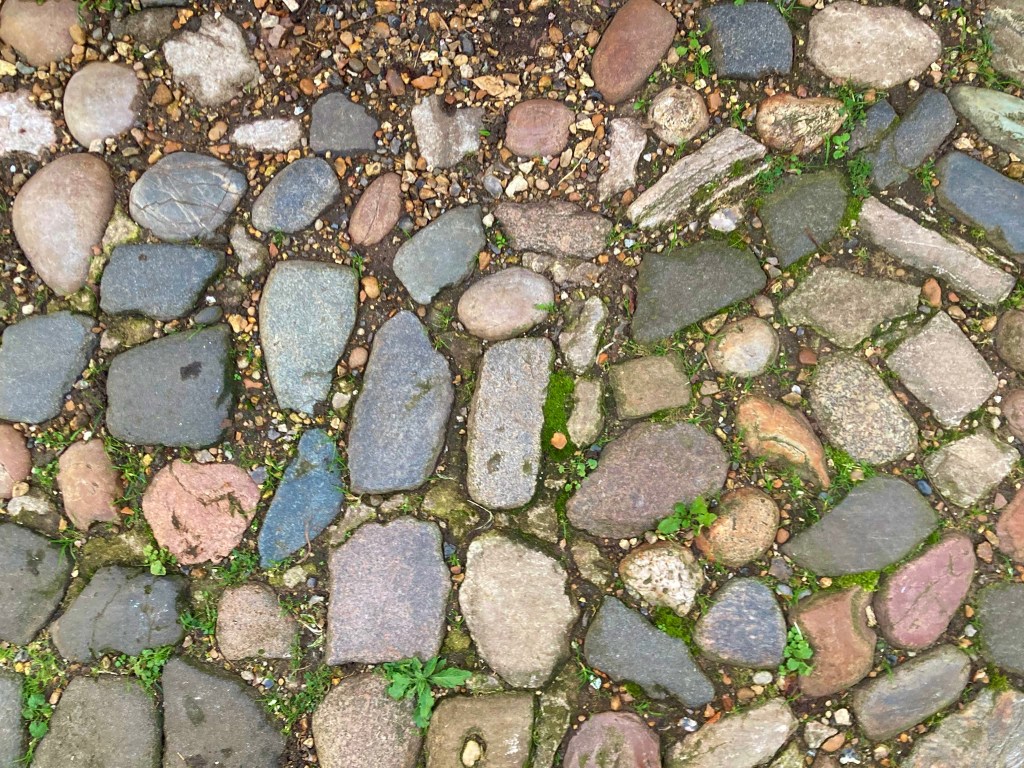
The pathway is made of random sized stones of different geologies.
They are large cobbles, a cobble being sized 64-256mm, i.e. 2.5 to 10 inches, with maybe one or two boulder size, – over 10 inches.
There is an almost certainly Cornish granite cartway or stoneway and what appears to be Portland Stone paving at the entrance.
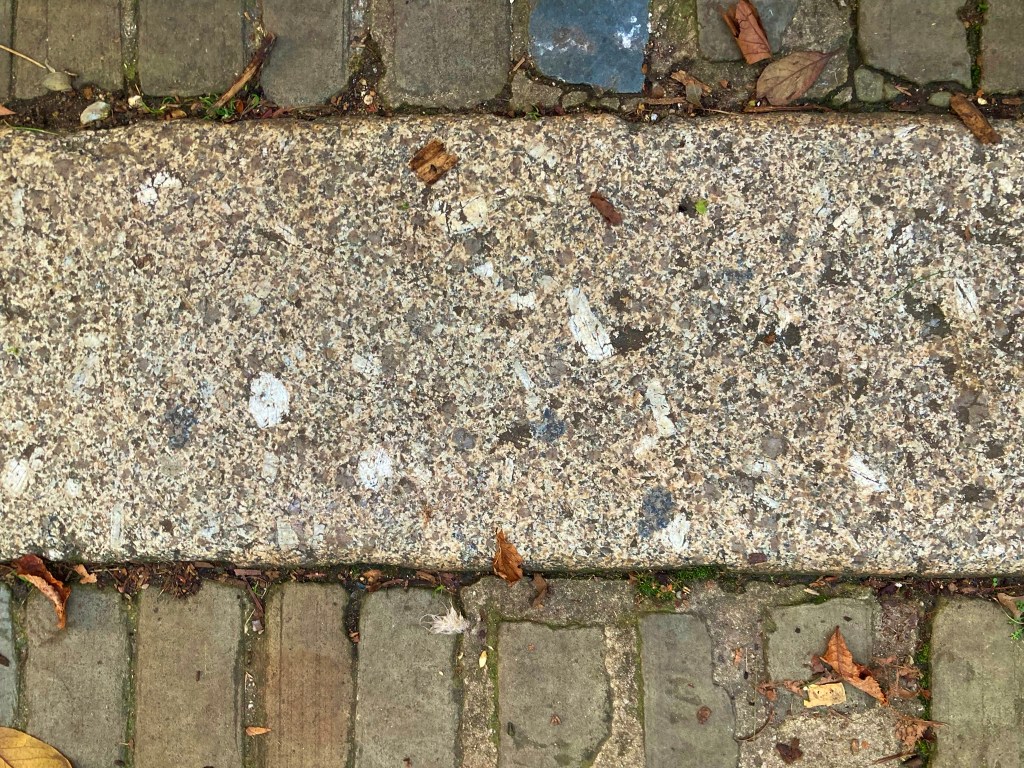
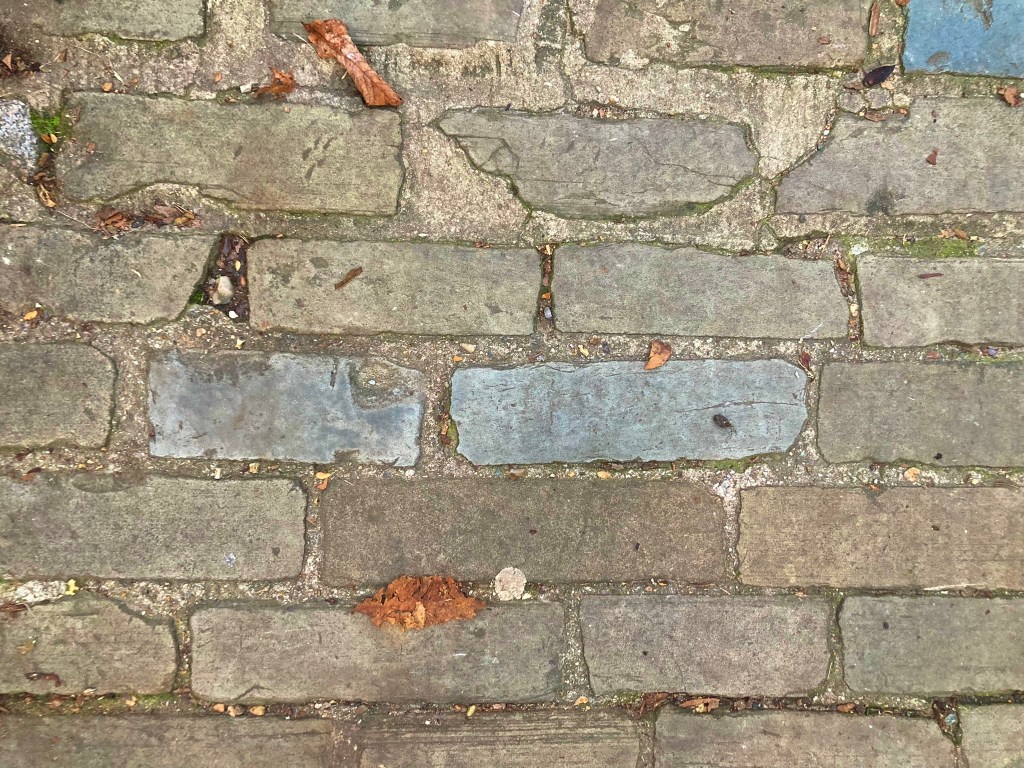
The cobbles themselves are, at least to a non-geologist, fairly un-identifiable – suggestions in the comments please! – except to note there is a dark red ‘ferricrete’ which suggests that it is locally sourced from Ice Age gravels in which ferricrete cobbles and boulders are produced. Quite possibly the stones are mainly quartzite. See the Building Stones of Essex for more detail. [1]
And indeed much of these stones could be from the Thames Valley glacial deposits which are know to carry quartzite cobbles – a metamorphic sandstone transported from many hundreds of miles during the Ice Ages.
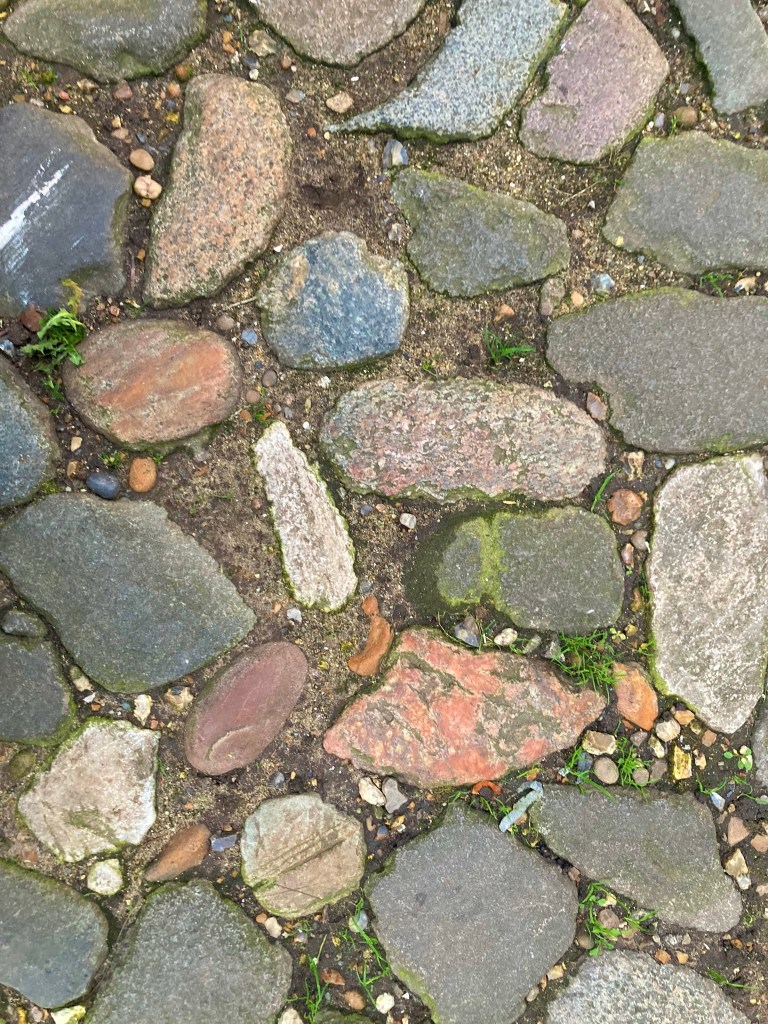
These cobbles would have been seen from the various gravels that often capped hill tops in the London area. [2]
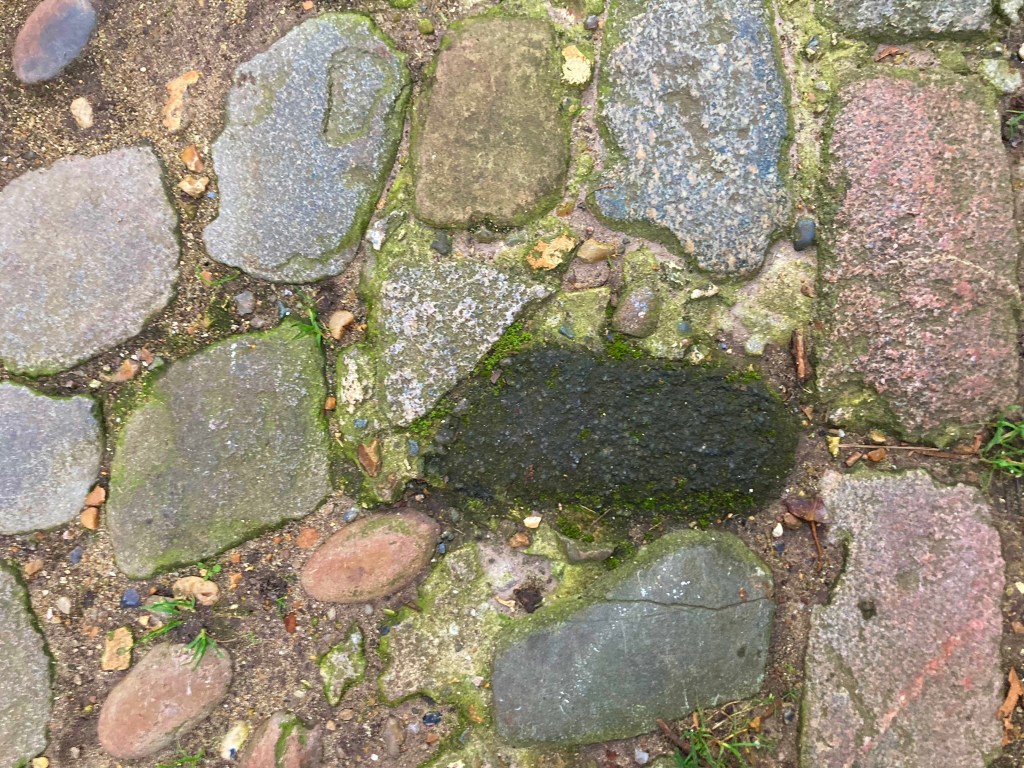
So the cobbles could be from regional glacial deposits OR, they could be ships ballast. All ships coming empty to the port of London had to carry ballast and they would offload it before taking on whatever they had come for. The brilliant Essex Rock and Mineral Society note this for Mistley in Essex: “On the south side of Mistley High Street, just east of the post office, is a brick wall with a panel composed entirely of rounded cobbles. Here can be seen numerous ‘exotic’ rock types such as granite, dolerite and gneiss and the distinctive Norwegian rock known as ‘rhomb porphyry’, of which there are at least eight examples here. The high number of the Scandinavian rocks in such a small section of wall is extremely unusual and, situated opposite the Baltic Quay on the adjacent Stour, and ‘Ballast Hill’ within the river, it is more than likely that these cobbles are of ships’ ballast from maritime trading 150 to 200 years ago. The wall is a geological museum of delight.” [3]
And from the Building Stones of Essex “Ballast – A wide variety of pebbles and cobbles are seen in the fabrics of some buildings (notably churches and inns) and in walls. The range of different stones typically includes igneous granites, syenites, dolerites, porphyries and lavas, and metamorphic amphibolites, gneisses … schists and phyllites. The proximity of these stones to coastal areas indicates they have been sourced from off-loaded ships’ ballast.” [1]
It is very likely these ballast stones would have ended up as building material and very possibly for pavements/roads.
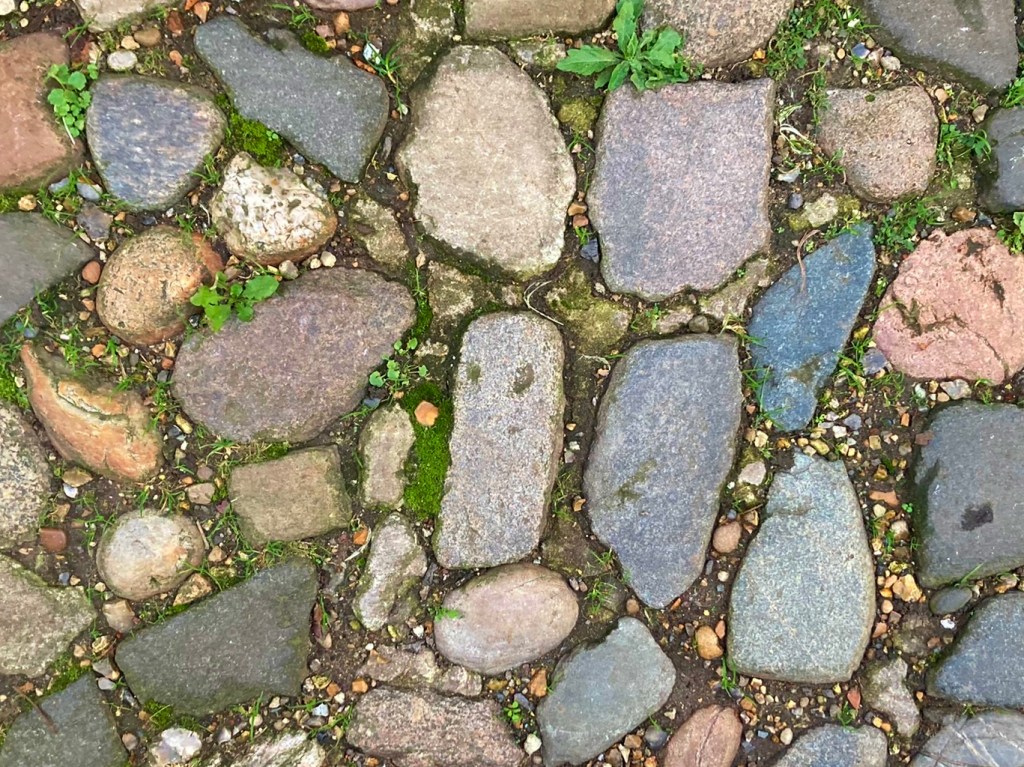
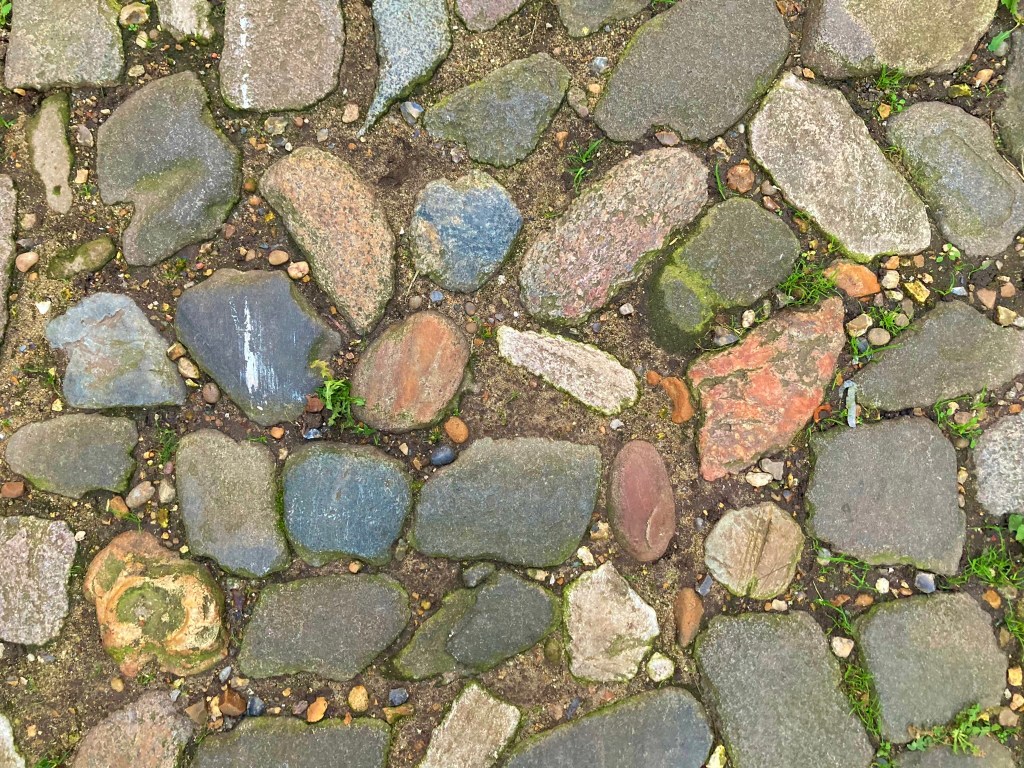
And in terms of the date of this road way, it appears to be fairly clear.
The English Heritage listing states that Nos 18-27 were built at c1780 by a Mr John Cheeke [4] and the London County Council Survey of London of 1938 notes re the terrace that “In 1782 they are headed “Cheeke’s Row,” after the builder John Cheeke”.
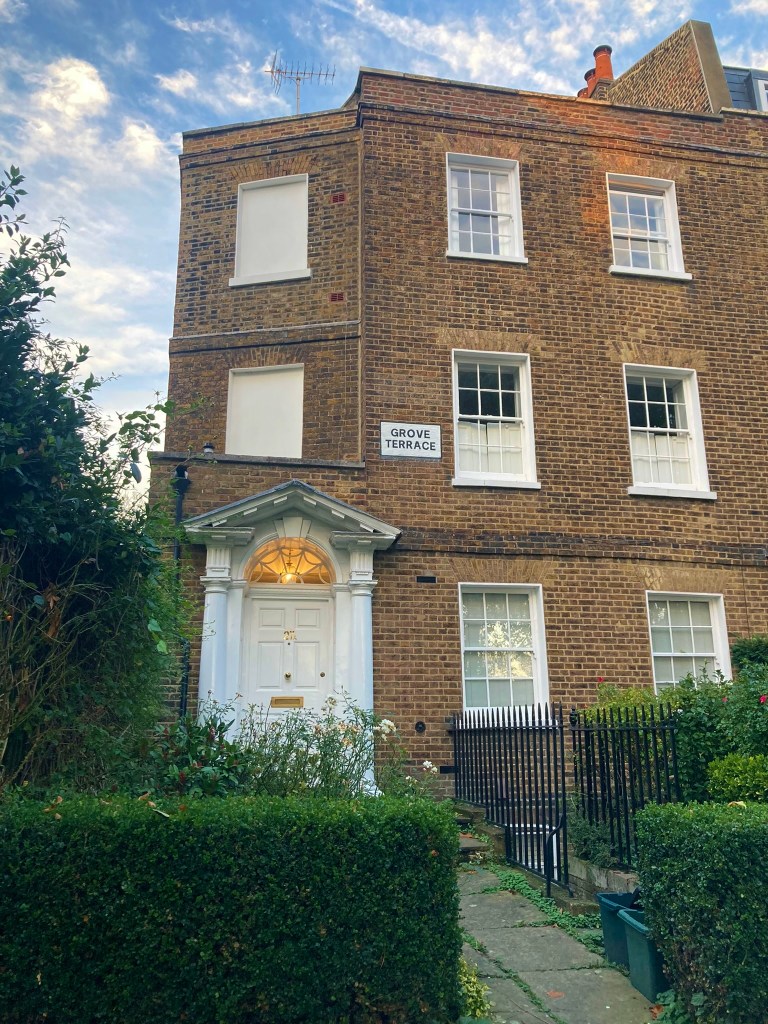
Does this mean that the late 18thC could be the date for other similar pavements like at Upper Watergate Street and Dean’s Yard? Quite possibly though again what is needed [ well what would be interesting at least ] would be an actually geologial analysis of the stones.
P.s. This seems like a good place to plug Ian and Ros Mercer who are leading lights in the Essex Rock and Mineral Society and who have not only authored the brilliant – clear, simple, detailed, well illustrated etc – ‘Essex Rock: Geology Beneath the Landscape’ published in 2022 – [ buy from Pelargic and all good booksellers [6] ] but the also brilliant “Geology in the old walls of Essex” web page and project [7] an exemplar of ‘pavement geology’! Their work opens up a world, geologically, historically and socially, in front of our eyes, when we look at walls and buildings and see and identify what they are made from. Brilliant!
Visiting
Grove Terrace is just off Highgate Road, opposite Parliament Hill School, and 5 minutes walk from Gospel Oak on the North London Line aka the London Overground
References
[1] p.34 https://historicengland.org.uk/images-books/publications/building-stones-england-essex/bse-essex/
[2] https://earthwise.bgs.ac.uk/index.php/London_-_Quaternary
[3] https://erms.org/geological-sites-in-essex/
[4] https://historicengland.org.uk/listing/the-list/list-entry/1246374
[5] Survey of London: Volume 19, the Parish of St Pancras Part 2: Old St Pancras and Kentish Town. https://www.british-history.ac.uk/survey-london/vol19/pt2/pp63-69
[6] https://pelagicpublishing.com/products/essex-rock
[7] https://erms.org/elementor-1027/
 Building London - what London is made from and where it came from!
Leave a comment